Cathodic Protection Training Course
Module 3
Thermo-dynamic theory of CP simplified.
I once received a letter from Dr David Scantleberry of the University of Manchester Institute of Science and Technology saying "You should get yourself a good book on electro-chemistry". Such books always refer to thermodynamics, the behaviour of electrons and energy.
In another instance, at the end of my presentation to the Institute of Corrosion Science and Technology in London in the 1980's, one of the delegates stood up and said that I had ignored the thermo-dynamic aspects of cathodic protection.
Happily, another delegate stood up, announced himself as having a PhD in the subject, and stated that I had satisfied him in all aspects.
However, these two incidents show that you will always be faced by someone who cannot rebutt your presentation of the facts, and who will resort to trying to confuse everyone with long words. It is for this reason that I have developed the ability to demonstrate and repeatedly confirm everything that I know about cathodic protection and corrosion.
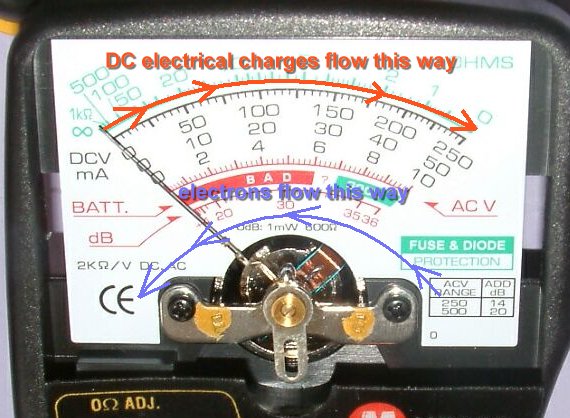
Thermo-dynamics deals with energy and corrosion releases energy in the form of electrons. These electrons flow in the opposite direction to that shown on a voltmeter as the direction of Direct Electrical Current (DC)
You will find some who want to show their superior knowledge by pointing this out. The answer is to agree and then ask if this is shown on any of the meters that have ever been used in the field by corrosion engineers.
This will only receive further attention when we can see an electron and see that it makes a difference to the practical application or measurement of cathodic protection. There are more complications that are already present in the study and practice of cathodic protection engineering.
The direction of the electron flow only confuses the matter and should be ignored.
The main point of the laws of thermodynamics, relating to corrosion and cathodic protection, is that the energy released by the chemical reaction between metals and their environments must complete a circuit to reach equilibrium. Everything must balance out and this is made clear by Newton and Einstein, followed through by Nernst, Gibbs and others and demonstrated by Faraday and all engineers.
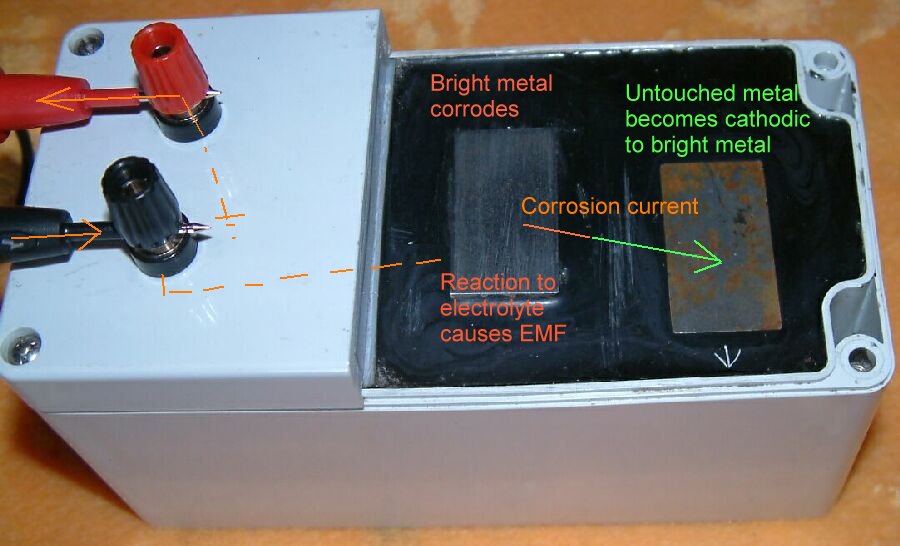
The metal disolves, giving off energy, which we can measure using a digital voltmeter. We can 'see' this corrosion happenning using and Alexander Cell.
This energy is sometimes called Electric Motive Force or EMF. This adds to the property known as 'electrical potential'of the eletrolyte which has disolved the metal. This is at the anode on top of the Alexander Cell.
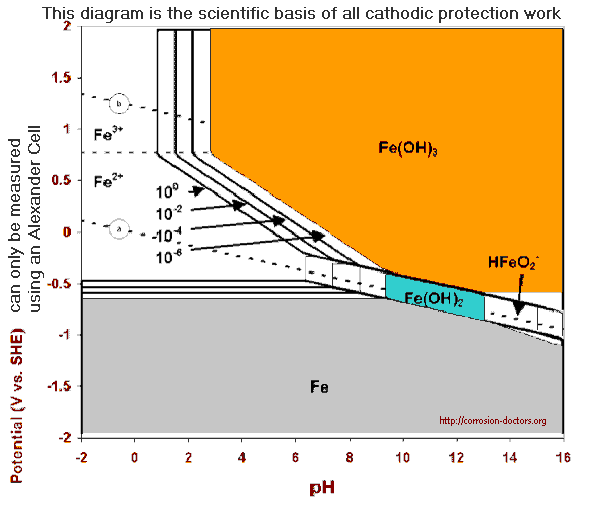
This electrolyte is then charged to a higher potential than the surrounding electrolyte to which the energy is radiated. In the case of the Alexander Cell, the sample of electrolyte with which the cell is 'fired up'is isolated from the ground and the only conductive path to complete the circuit is through the cathode on top of the device. We therefore have the only method to make the measurements that are necessary to use the Pourbaix Diagram or the Nerst Equations in the practical application of cathodic protection.
The use of the half-cell or any other reference electrode CANNOT render the data required by all of the theories used in cathodic protection!
We will study the whole of the circuit in detail later in this course.
The thermodynamics and all codified science is important in that it is the law by which the whole world works.
In this case we have a law that applies to each corrosion cell and we are dealing with millions of individual cells on every length of pipeline. This will include micro-corrosion cells on a single coating fault, long line corrosion cells that can have their anodes separated from their cathodes by several meters and complex combinations of corrosion reactions.
It is all very well knowing how to control each individual corrosion reaction if we are in a laboratory or trying to design a battery charger but we have to create a system that will stop all corrosion reactions on a variety of structures made from a variety of metals in a variety of environments.
Each of these reactions has a direct effect on all of the others. The application of simple rules like the Nerst Equations and Gibbs free energy etc are only relevant if we have a method of measuring the values that are incorporated in them.
In practical work the measurement is complicated by the fact that the electrical balance of the circuit formed by connections between all the metalic structure must be measured in 'open circuit' as they are all submerged in common electrolyte of infinitely variable conductivity.
We therefore need the skills of electronic engineers and considerable computer power to analyse the true status of each corrosion reaction.
Back to Module 03 index page